A newly funded development effort aims to make testing experimental applications and system-level changes on GNOME OS, GNOME’s own experimental OS, considerably easier, particularly for people who are not comfortable dealing with Flatpak bundles, unofficial repositories, or manual command-line installation.
The initiative, officially named the GNOME OS Developer Tool Suite and supported by Germany’s Prototype Fund, focuses on tools to build, share, and test extensions for image-based operating systems locally.
Members of Modal Collective are leading the project and have spent the past month gathering feedback from GNOME community developers as the team now moves into prototyping.
The proposal centers on a new application, tentatively called Test Center, designed to simplify downloading, installing, and managing experimental GNOME applications.
Currently, developers use CI systems to generate Flatpak bundles for individual merge requests. Although this has improved application testing, the workflow remains relatively technical because testers must manually download, install, and later remove the appropriate bundle.
Test Center aims to address this by offering an experience similar to Apple’s TestFlight. Developers would provide a simple sharing link that testers could use to install the experimental application.
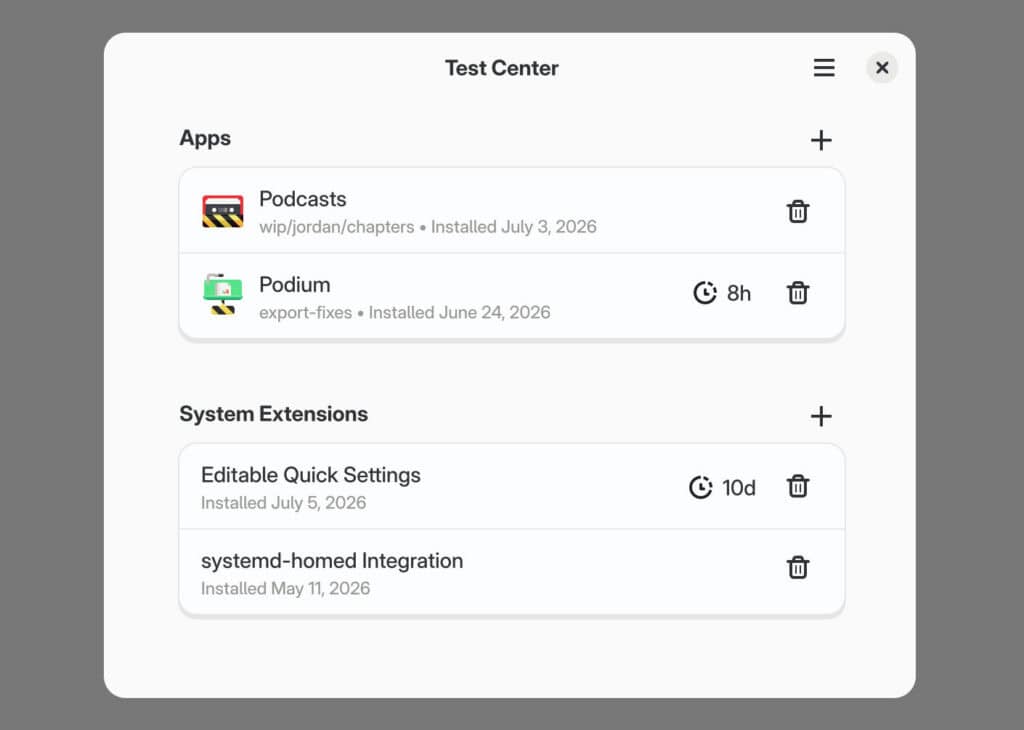
Test builds would be clearly marked as experimental, reducing confusion with stable versions. Developers could also set an expiration period, ensuring temporary builds do not remain installed indefinitely.
Importantly, Test Center would not be limited only to regular desktop applications. Modal Collective also plans to use the same interface for testing experimental versions of lower-level system components. This would help evaluate features that require changes beyond standalone Flatpak applications, such as new parental controls or modifications to core GNOME components.
On conventional package-based Linux distributions, testing such changes often requires developers to build replacement packages and publish them through unofficial repositories such as COPR or PPA. Testers must then replace stable system packages with experimental versions, which can lead to broken dependencies, missed updates, or an unusable system.
The proposed GNOME OS workflow would instead generate a system extension image, commonly known as a sysext, for each relevant merge request. Test Center could then install the experiment from a sharing link and apply it as an overlay on top of the existing operating system.
Since the underlying system files are not permanently replaced, removing the extension restores the machine to its original state. Moreover, the broader GNOME OS Developer Tool Suite also addresses a key limitation of image-based Linux systems: installing command-line development tools.
Traditional Linux distros make it easy to install specialized utilities through package managers. GNOME OS already provides a development system extension containing some commonly used tools, but a single image cannot realistically include every specialized utility developers may need.
Flatpak is also primarily designed around graphical desktop applications and is not considered a suitable general-purpose solution for terminal programs.
Modal Collective says it has discussed the issue with Flatpak developers and already has an initial approach for distributing third-party command-line tools. More details are expected to be shared separately as that part of the project develops.
For more details, see the Modal Collective’s blog post.
Image credits: Modal Collective