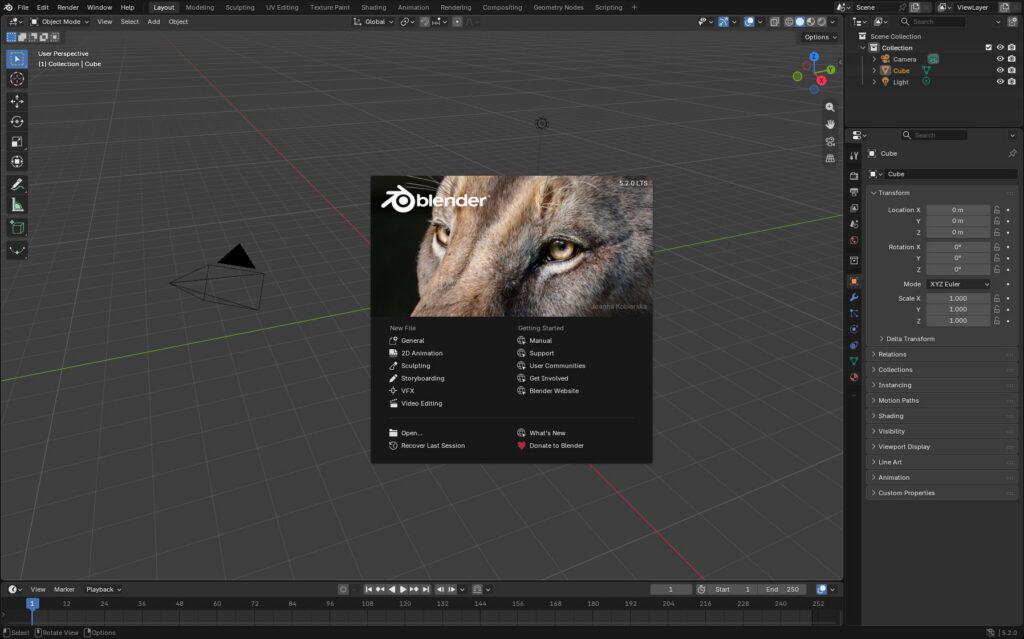
The Blender Foundation has announced the release of Blender 5.2 LTS, the latest long-term support version of the popular free and open-source 3D creation suite.
Among the most notable additions is an experimental physics system built around Geometry Nodes, initially focusing on cloth and hair simulations. Instead of relying exclusively on Blender’s traditional, largely fixed simulation systems, users can now create and customize physical behavior through procedural node graphs.
However, keep in mind that the new physics tools are still considered experimental, as their design and interfaces may need to evolve based on real-world testing and feedback.
Blender 5.2 also introduces lists as a new Geometry Nodes data type. Lists can store an arbitrary number of values, opening the door to procedural setups that need to collect, organize, and process sequences of data rather than operate only on individual values or geometry components.
Another major Geometry Nodes development is the introduction of functions, which allow Node groups to be configured as reusable functions that receive values, perform operations, and return results without necessarily processing geometry.
Blender 5.2 LTS also brings online asset libraries directly into the application. Remotely hosted libraries can now be registered and browsed directly in Blender’s Asset Browser, with individual assets downloaded only when required. In addition, assets from these libraries can also appear contextually in Blender’s menus.
Cycles users receive a new texture-caching system designed to reduce memory consumption in scenes containing many large image textures. Once enabled from the Performance section of the render properties, Blender can generate optimized .tx files for the images used by the scene. Cycles then loads the required texture data more selectively, rather than keeping every full-resolution image in memory.
EEVEE also receives attention, with its screen-space ray-tracing pipeline undergoing a major cleanup. Because of the scope of the changes, some existing projects may show differences when opened in Blender 5.2.
Blender has additionally brought its optimized object-instancing system to EEVEE. Scenes containing large numbers of repeated objects, collection instances, vegetation, architectural components, or crowd elements should now require less CPU work when displayed.
Grease Pencil artists can take advantage of a completely new Fill tool based on a Delaunay solver. The new implementation creates precise geometry from surrounding boundary strokes and includes automatic gap detection, inverse filling, and behavior that is consistent at different zoom levels.
On top of that, the Grease Pencil brush library has been updated, and materials with dot and square patterns now have new placement controls. These patterns can now be produced more efficiently during rendering, rather than requiring artists to generate large amounts of additional geometry.
Sculpt Mode includes a Scene Project brush that moves vertices toward surfaces belonging to other objects in the scene. It provides an interactive way to fit or project sculpted forms against surrounding geometry without constantly switching between sculpting and modifier-based workflows.
Blender 5.2 also adds VR Location Scouting, a new tool for exploring virtual sets from inside a VR headset. Artists can move through a scene, evaluate possible camera viewpoints, and block out camera positions from within the environment.
Color-management workflows have been expanded with additional input color spaces for footage recorded with cameras from Apple, ARRI, Blackmagic Design, Canon, and Sony.
Other rendering improvements include easier copying of light- and shadow-linking configurations between objects. Plus, the modeling toolset now includes a native Circle operator based on the familiar tool previously supplied through the bundled LoopTools add-on.
The Select Linked tool also gains more delimiter options, allowing connected selections to stop at seams, marked sharp edges, or material boundaries. This gives modelers finer control when selecting parts of otherwise continuous geometry.
For compositing, Blender 5.2 adds support for more Geometry Nodes-style socket and node types, including matrices and rotations. The File Output node also receives an independent option for controlling file extensions rather than relying entirely on the corresponding scene render setting.
The Video Sequencer now lets users choose which view layer a scene strip should display. Sequencer scopes have also been improved for HDR and wide-gamut color workflows, providing more useful visual feedback when working with footage that goes beyond conventional standard-dynamic-range color spaces.
Additional improvements are spread throughout the application. The glTF exporter gains point-cloud support, annotation strokes can now be created and edited through Blender’s Python API, and high-resolution footage playback has been optimized in the Movie Clip Editor.
Finally, the user interface includes numerous smaller refinements, such as a command to quickly swap horizontal and vertical render dimensions.
Blender 5.2 is now available for download for Linux, Windows, and macOS from the project’s website. For a complete list of changes, refer to the release notes. The official announcement is here.
As usual, Linux users can choose among the distribution-neutral archive offered by Blender, packages provided by their preferred distribution, or a third-party software repository.