TUXEDO OS Leaves Ubuntu Behind for a Debian Testing Base
TUXEDO Computers has announced a major change for its in-house Linux distribution, TUXEDO OS, revealing that Ubuntu will no longer serve as its foundation. Instead, future versions of the distro will be based on Debian Testing.
According to the company, the decision arrives after several months of reduced update cadence, especially around KDE Plasma updates. While Plasma 6.7.x is already available upstream, TUXEDO OS is still based on Plasma 6.5.x, and the company had not previously given a precise timeline for moving existing users to an Ubuntu 26.04 LTS base.
Now we know the main reason behind this: TUXEDO OS is leaving Ubuntu behind. Until now, TUXEDO OS has followed a hybrid release model which combined a stable Ubuntu LTS base with more frequently updated components such as the Linux kernel, web browsers, NVIDIA drivers, the graphics stack, and KDE Plasma.
However, TUXEDO says this model has become increasingly difficult to maintain as Ubuntu LTS releases age. According to the company, backporting modern software to an older package base requires more work over time, especially when newer applications depend on libraries that are either missing or outdated in the underlying distribution.
Additionally, the company also points to deeper technical problems. Updating central components such as Qt, which KDE Plasma heavily depends on, can break software from Ubuntu’s repositories.
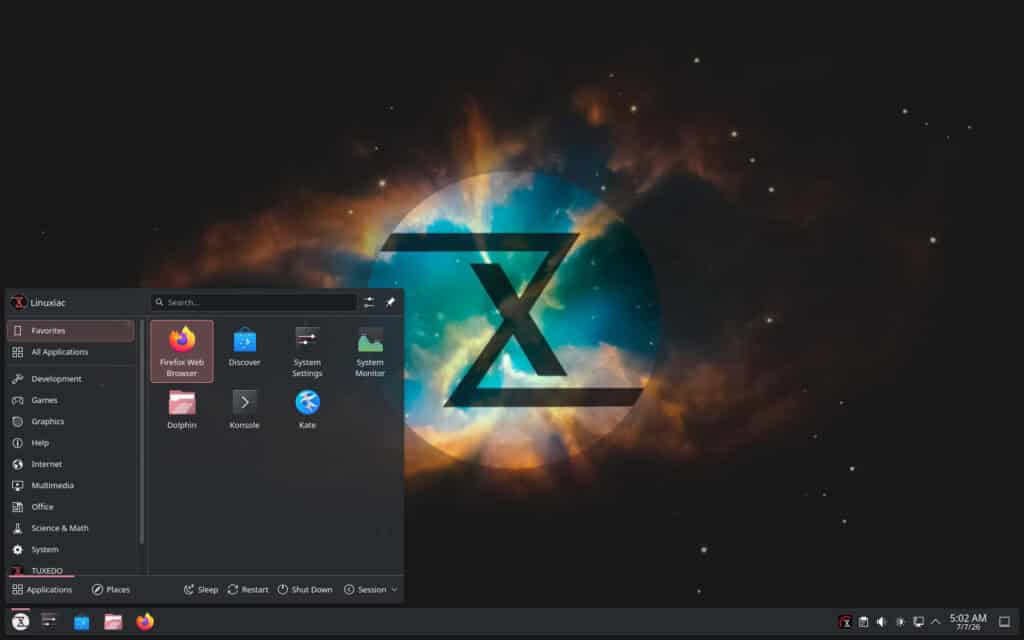
But the technical maintenance is only part of the story. TUXEDO also cites Canonical’s strategic direction as one of the reasons for the move. In particular, the company says it has become harder to keep Snap out of the operating system, as Canonical continues to move more applications toward Snap packages while traditional DEB packages become less central.
TUXEDO also mentions Canonical’s AI roadmap, announced by Mark Shuttleworth during the Ubuntu Summit 26.04, saying that its concrete implementation is still not transparent enough. In addition, the company believes that some security updates sometimes take longer to reach users than necessary.
As a result, TUXEDO OS is moving to Debian, the very distribution on which Ubuntu itself is based. However, the new TUXEDO OS will not use Debian Stable. Instead, it will be based on Debian Testing, since the current stable Trixie release is intentionally conservative.
Debian Testing, on the other hand, provides a more current package base. For TUXEDO, this gives the distribution a more flexible foundation while still staying within Debian’s well-established package ecosystem.
Importantly, TUXEDO OS will not switch to Debian Stable once Debian 14 is released. Instead, Debian Testing will remain its permanent base. TUXEDO calls this approach “Continuous Debian,” describing it as a better fit for the distro’s existing hybrid release concept.
For users, the day-to-day experience should remain mostly familiar. TUXEDO OS will continue using the same package management system, updates will still be available through Discover or the command line, and the general system structure will remain largely unchanged.
Core components such as the kernel, browsers, and graphics stack will continue to receive frequent updates. That should help TUXEDO maintain support for newer hardware, which is especially important for a vendor shipping Linux preinstalled on modern laptops and desktop systems.
Another major change is the default file system. Going forward, TUXEDO OS will use Btrfs by default, together with automatic system snapshots and rollback functionality powered by Snapper.
Before package management operations, such as installing updates as well as adding new software, the system will automatically create a snapshot. If something goes wrong, users should be able to roll back to a previous working state within minutes. Manual snapshots will also be possible, for example before making larger configuration changes.
TUXEDO says Btrfs will be used by default for installations performed through WebFAI and on all new systems. The ISO installer will also preselect Btrfs, although users will still be able to choose another file system if they prefer. However, choosing a different file system means snapshot and rollback functionality will not be available.
A beta testing phase is expected to begin in the coming weeks. TUXEDO will provide ISO images for testing, but the company recommends using them only in non-production environments for now.
Unfortunately, there is one important catch for existing users: there will be no safe crossgrade path from the current Ubuntu-based TUXEDO OS to the new Debian-based version. So, in the end, a clean installation will be required.
The good part is that TUXEDO says it will publish a migration guide before the final release to help users transfer their personal data. For those who prefer to stay on an Ubuntu-based system, the company plans to provide a migration path to Kubuntu 26.04.
For additional details, see the official Tuxedo announcement.